





Imagine this situation…
You are working on a large building (BIM) project as an engineer. The architect is preparing the building model, the HVAC engineer is designing ducts, the electrical engineer is planning cable routes, and the plumbing engineer is working on water systems. But suddenly someone asks a question during the coordination meeting:
“What LOD is this model?”
If you are a student or a fresher in the construction or design industry, that question might sound confusing.
What exactly is LOD in BIM?
Why do engineers talk about it so often?
How does it affect real construction projects?
If you’re curious about Building Information Modeling (BIM) and planning to build a career in the design engineering field, understanding Level of Development (LOD) is very important. Let’s break down the details on LOD in our JSE Engineering Academy Blog, simply and practically.
What is BIM and Why is it Important in Modern Construction?
Before we understand LOD, we need to understand the concept of Building Information Modeling (BIM). BIM is a digital process used in the Architecture, Engineering, and Construction (AEC) industry to design, manage, and coordinate building projects using intelligent 3D models.
Unlike traditional drawings, BIM models contain detailed information about building systems such as:
- HVAC systems
- Electrical systems
- Plumbing networks
- Fire protection systems
- Structural elements
Because all disciplines work on a shared digital model, engineers can detect design conflicts early and improve project coordination. This technology has transformed the construction industry, making BIM one of the most valuable skills for modern engineers.
What Does Level of Development (LOD) Mean in BIM?
Now let’s talk about Level of Development (LOD). LOD refers to the amount of detail and reliability included in a BIM model at different stages of a project.
In simple terms, LOD tells engineers:
- How detailed the model is
- How accurate the information is
- Whether the model can be used for construction or only for design planning
Think of LOD like the progress level of a building model.
At the early stages of a project, models contain only basic shapes and approximate information. As the project progresses, more details are added until the model becomes precise enough for construction and facility management. Understanding LOD helps teams know how much they can trust the model at each stage of the project.
Why LOD is Important in BIM Projects
In large construction projects, multiple teams work together. Without clear standards, different engineers might create models with varying levels of detail, which can lead to confusion. LOD standards help maintain consistency across the project.
With proper LOD definitions, project teams can:
- Understand the expected level of model accuracy
- Avoid unnecessary modeling work in early design stages
- Improve collaboration between engineering disciplines
- Reduce construction errors and delays
This is why LOD has become an essential concept in BIM project management.
Different Levels of Development in BIM
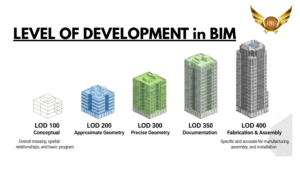
LOD typically progresses through several stages as the project develops.
Each stage represents a higher level of detail and accuracy in the model.
LOD 100 – Conceptual Design Stage
At LOD 100, the BIM model represents the overall concept of the building. The model includes basic elements such as approximate building shape, size, and location.
At this stage, engineers mainly focus on project planning and initial feasibility studies, rather than detailed engineering design. The model helps stakeholders understand the general building layout and design intent.
LOD 200 – Approximate Geometry
At LOD 200, the model begins to include more defined elements.
Building systems such as ducts, pipes, and electrical components may appear in the model, but their exact sizes and locations may still be approximate. This stage allows engineers to begin coordination between disciplines and understand how systems may fit within the building structure.
LOD 300 – Precise Design Information
LOD 300 represents a major milestone in BIM modeling. At this level, model elements include accurate dimensions, locations, and quantities.
Engineers can use this model for:
- Detailed design coordination
- Clash detection between building systems
- Construction documentation preparation
Most engineering design work happens around LOD 300.
LOD 400 – Fabrication and Construction Level
At LOD 400, the model includes very detailed information suitable for fabrication and installation.
Contractors and fabricators use these models to manufacture building components such as:
- HVAC ductwork
- piping systems
- electrical cable trays
- fire protection systems
This stage connects the digital model directly with the physical construction process.
LOD 500 – As-Built Model
LOD 500 represents the final stage of the BIM model. This model reflects the actual building as constructed on-site.
Facility managers use LOD 500 models for:
- building maintenance
- system inspections
- renovation planning
This stage ensures the building’s digital model remains useful even after construction is completed.
How LOD Helps Engineers Work More Efficiently
Understanding LOD helps engineers plan their work effectively during BIM projects. Instead of modeling unnecessary details too early, engineers can gradually develop models according to project requirements.
This improves:
- project workflow efficiency
- collaboration between engineering teams
- model accuracy and reliability
For engineers working in BIM-based design environments, understanding LOD is considered a fundamental professional skill.
Learning BIM and LOD Concepts at JSE Engineering Academy
For engineering and diploma graduates interested in the BIM and design engineering field, gaining practical knowledge of these concepts is essential. JSE Engineering Academy provides specialized training programs that help students understand BIM workflows and engineering system design used in real construction projects.
Students receive hands-on training in areas such as:
READ BLOG: Master HVAC Design Course and Career Opportunities
- Building Information Modeling (BIM)
- Revit MEP
- AutoCAD drafting
- HVAC system design
- Electrical system design
- Public Health engineering (plumbing systems)
- Fire Fighting System Design
These courses are designed to help graduates develop industry-ready skills for modern engineering projects.
Understanding Engineering Systems Through VR Learning
One of the unique learning experiences offered at JSE Engineering Academy is the use of Virtual Reality (VR) sessions. VR technology allows students to explore digital building models in an immersive environment.
Through VR, students can:
- visualize HVAC ducts, pipes, and cable routes inside buildings
- understand coordination between engineering disciplines
- experience real project environments in 3D
This approach makes complex BIM concepts easier to understand.
Training Centers Across Tamil Nadu
JSE Engineering Academy provides training opportunities for students across multiple locations.
The academy operates in:
- Chennai
- Tirunelveli (Nellai)
- Trichy
- Visakhapatnam (Vizag)
Students from different regions can therefore access industry-focused BIM and engineering training programs.
100% Job Placement Opportunity After Certification
A major advantage for students enrolling at JSE Engineering Academy is the job placement opportunity after course completion. Students who complete their certification receive 100% job placement opportunities in JSE Engineering Private Limited.
JSE Engineering Pvt Ltd is an ISO-certified multi-disciplinary engineering solutions company delivering BIM and design services for global construction projects.
Graduates trained through the academy often gain opportunities to work on projects in:
READ BLOG: Top Software Courses for Engineers in Tamil Nadu
- India
- Middle Eastern countries such as Dubai, Qatar, and Saudi Arabia
- international construction and infrastructure projects
Why BIM Skills Are a Smart Investment for Engineers
The construction industry is rapidly adopting digital technologies, and BIM has become the standard workflow for many international projects.
Engineers who understand BIM processes, Revit modeling, and LOD standards will have a significant advantage in the job market.
YOU MAY READ BLOG: Is BIM course worth it in 2026? Career Scope and Complete Guide
For engineering and diploma graduates looking to build careers in the design engineering field, learning BIM and related software with JSE Engineering Academy, the best MEP Training Centre, can open doors to exciting opportunities across the global construction industry.